
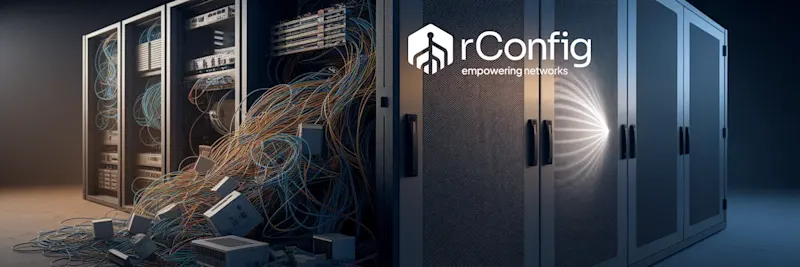
Many IT leaders believe their networks are manually managed, holding off on automation because they fear the risk. Here’s the uncomfortable truth: your network is already automated. It’s just happening in the shadows, through a chaotic mix of ad-hoc scripts, forgotten cron jobs, and processes that exist only in the minds of a few senior engineers. This is shadow automation, and it’s far more dangerous than any formal platform.
The real conversation isn't about whether to introduce automation. It’s about how to find, tame, and govern the unmanaged network automation that’s already creating significant hidden automation risk across your infrastructure. The choice is not between manual work and automation, but between chaos and control.
The Uncomfortable Truth About Your Network's Automation
Let's challenge a common assumption. The belief that your network lacks automation is likely a comforting fiction. In reality, automation is already there, operating in a fragmented and undocumented state. This collection of ad-hoc scripts, scheduled tasks, and manual workarounds that function without formal oversight is what we call shadow automation. It’s the Perl script an engineer wrote a decade ago to reboot a switch, the nightly cron job that pulls a report, or the series of commands someone copy-pastes from a text file to deploy a new VLAN.
This patchwork system is the source of immense hidden automation risk. The primary danger isn't adopting a formal automation platform. It's ignoring the existing unmanaged network automation that has quietly become part of your daily operations. The question your team should be asking is not "Should we automate?" but rather, "How do we govern the automation we already depend on?"
Identifying the Symptoms of Shadow Automation

If you think this problem doesn't apply to you, the data suggests otherwise. A recent EMA 2024 research report reveals a startling statistic: 84% of surveyed organizations still maintain their own DIY network automation scripts. This reliance on homegrown solutions creates a predictable set of symptoms. See if any of these sound familiar.
- Islands of Automation: Scripts written in Python, Bash, or Expect are scattered across different systems and tools. As Gartner has found, this fragmentation often occurs across three or more tools, creating isolated pockets of automation with no single point of control or ownership. One team might use a script for backups, while another has a different one for compliance checks, with neither team aware of the other's work.
- Brittle Scripts and Tribal Knowledge: The most dangerous form of shadow automation is the script stored on a single engineer's laptop or personal repository. This is the essence of brittle scripts networking. When that engineer leaves the company, the institutional knowledge of how that script works, what it depends on, and why it was created walks out the door with them. The script becomes a black box that everyone is afraid to touch.
- Lack of Version Control and Testing: These ad-hoc scripts almost never benefit from basic software development practices. There is no version control to track changes, no pre-deployment testing in a lab environment, and no documentation to explain what the script does. Each time a script is run, you are essentially rolling the dice, hoping it doesn't trigger an outage.
How Ungoverned Scripts Translate to Business Risk
The technical debt from shadow automation inevitably leads to tangible business consequences. The same EMA study concluded that manual errors, often facilitated by these flawed scripts, are a primary cause of network issues. Consider a real-world scenario from a Fortune 500 retailer. A nightly cron job ran an old Expect script to update firewall rules based on a CSV file. One day, an employee accidentally added a stray space while editing the file. The script, lacking any error handling, generated a malformed configuration and pushed it to the production firewall, blocking the company's primary payment gateway for hours.
The hidden automation risk became a financial catastrophe, causing direct revenue loss and forcing engineers to waste hours troubleshooting a problem that a governed system would have caught instantly. This is precisely what the EMA report warns about in its section on the "Consequences of Manual Data Gathering." Without validation, even the simplest automated task can bring down critical services. The contrast between ungoverned and governed automation is stark.
| Risk Factor | Unmanaged 'Shadow' Automation | Governed NCM Automation |
|---|---|---|
| Change Execution | Ad-hoc scripts run directly on production | Validated, scheduled, and RBAC-controlled execution |
| Auditability | No centralized log; 'tribal knowledge' | Immutable audit trail of who, what, and when |
| Error Handling | Silent failures, manual troubleshooting | Automated validation and instant rollback |
| Configuration State | High risk of configuration drift | Single source of truth prevents drift |
| Business Impact | High potential for outages and compliance fines | Reduced MTTR and proactive risk mitigation |
This table outlines the fundamental differences in risk exposure between relying on undocumented scripts and implementing a formal Network Configuration Management (NCM) platform.
Shifting from Chaos to Control with Formal NCM

The solution to this chaos is not to abandon automation but to formalize it. A Network Configuration Management (NCM) platform is not an added layer of complexity. It is the essential framework for taming the unmanaged network automation that already exists. It brings order by establishing foundational controls that eliminate the risks of homegrown scripts.
First, an NCM platform creates a single source of truth. By maintaining a centralized, version-controlled repository of all network configurations, it eliminates the configuration drift caused by manual network automation and ad-hoc changes. Everyone works from the same playbook.
Second, it introduces automated validation. Before any change is pushed to the live network, it can be tested in a safe, simulated environment. This simple step prevents errors like the malformed CSV file in the retailer example from ever reaching production. Finally, it provides a safety net. If a change does introduce an issue, a proper NCM system provides automated rollback and version control capabilities to instantly revert to the last known good configuration, dramatically reducing Mean Time to Recovery (MTTR).
Building a Foundation of Governance and Auditability
Once you have tactical control, the next step is to build strategic NCM governance. This is about ensuring security, compliance, and accountability across all network operations. As Gartner's Market Guide for Network Automation Platforms highlights, platforms that support end-to-end workflows are critical for scaling automation without increasing fragmentation. A formal NCM platform provides the guardrails that make automation safe at scale.
Key governance functions include:
- Role-Based Access Control (RBAC): This enforces the principle of least privilege. You can define precisely who is authorized to execute specific changes on designated devices. A junior engineer might only have permission to run diagnostic commands on access switches, while a senior engineer can modify core router configurations. This prevents unauthorized or accidental changes.
- Immutable Audit Trail: A governed platform creates a complete, unchangeable log of every action: who made a change, what the change was, when it was made, and whether it was successful. This detailed audit trail is invaluable for incident forensics and is often a mandatory requirement for compliance standards like SOX, PCI-DSS, and HIPAA.
These capabilities are central to a true enterprise-grade solution that scales with your organization. As Holly Holcomb, VP of Marketing at Itential, wisely stated, "Governance is what separates a successful automation strategy from a collection of scripts that become a liability."
The Next Step: Proactive and Intelligent Governance

Adopting a formal NCM platform is not just about cleaning up past mistakes; it is a forward-looking strategy. The EMA 2024 report notes the rise of AI/ML-driven automation, and modern NCM platforms are evolving from passive management tools into proactive, intelligent systems. This shift is powered by emerging AI-driven automation features that can predict issues and suggest corrective actions before they impact service.
This evolution leads to concepts like intent-based automation. Here, you define the desired "intended" state of your network, and the platform continuously monitors the live environment to ensure it aligns with that intent. If it detects configuration drift, it can automatically flag the discrepancy or even remediate it. This transforms governance from a static checklist into a dynamic, self-healing system that actively reduces operational risk. It’s no surprise that budget allocations for network automation are rising as organizations look to replace their brittle scripts networking with intelligent, reliable platforms.
The Real Choice Is How You Govern Automation
The "no automation" stance is a myth. Your network is already automated, and pretending otherwise exposes your business to significant risk. The real question is whether you will continue to rely on the fragile, unauditable world of shadow automation or move to the reliable, secure world of a governed NCM platform.
One path leads to silent failures, configuration drift, and long nights spent troubleshooting outages caused by a stray character in a forgotten script. The other leads to predictable outcomes, automated compliance, and the ability to make changes with confidence. We believe the choice is clear.
We urge IT, network, and security leaders to audit their environments for signs of unmanaged network automation. It's time to make a strategic decision to migrate those fragile processes into a formal framework. The first step is to gain visibility and control with a platform built for modern network challenges, like rConfig.